


Properties & Qualities
Application
Art, Sample making
Qualities
2D, Colourful, Rigid, Translucent
Colour
Red
Sample Information
Date of creation
09/21/2019
Process & Production
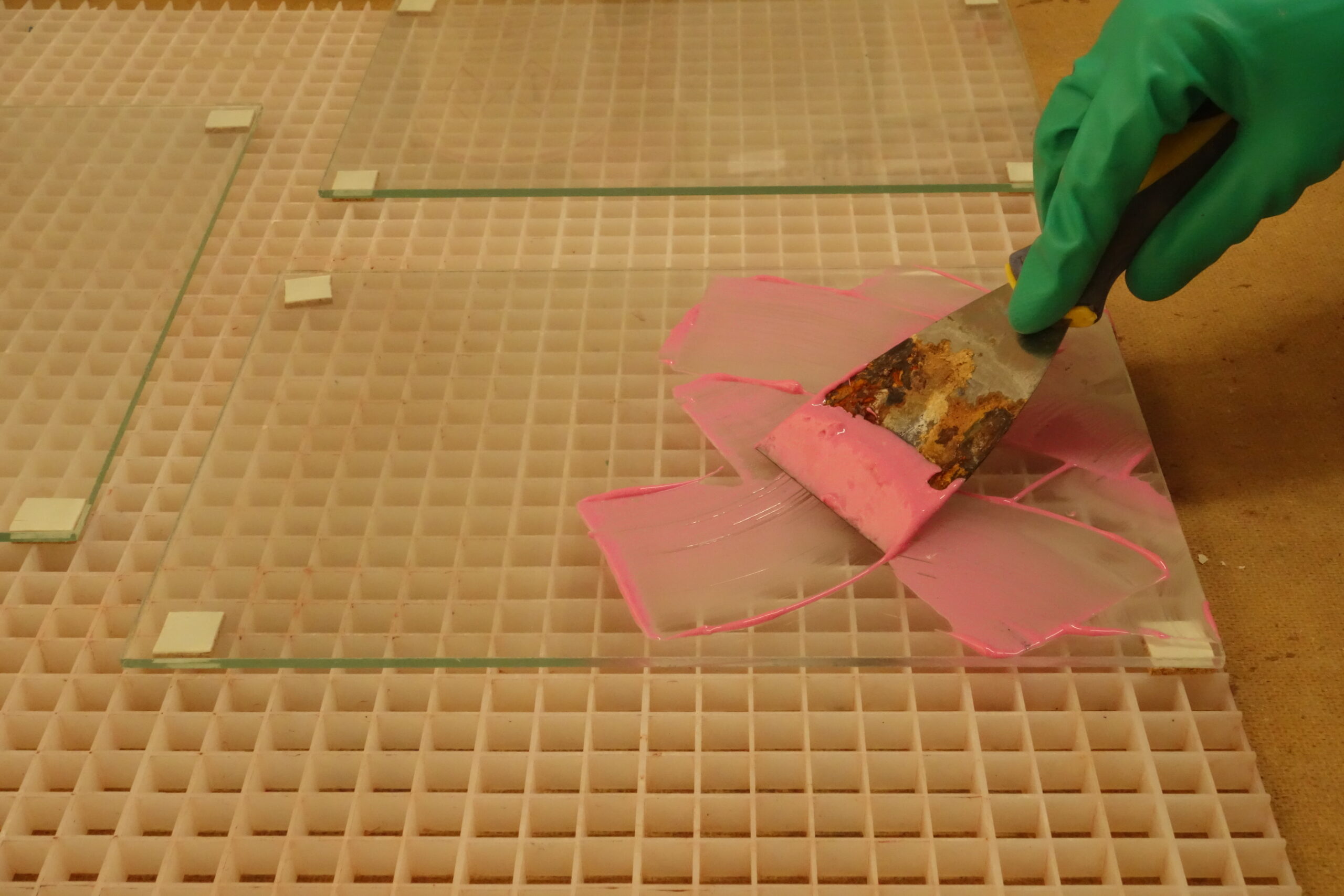
This recipe consisted of a mixture of three materials, iron(II) sulphate heptahydrate (FeSO4·7H2O), lead-silica glass (PbO·SiO2), and red earth (Crayon Rouge) (Al2O3-SiO2-Fe2O3) in the proportion of 4:4:1 by wt. The lead-silica glass had been previously prepared according to Félibien (1676) and Blancourt (1697) (PbO: SiO2, 3:1 by wt). This mixture was then ground in water and painted on a glass with gum Arabic dissolved in distilled water. Finally the paint was fired at 620ºC for 30 minutes (ramp 3ºC/minute).
Find more at:
Â. Santos, M. Vilarigues (2019). Sanguine Paint: Production, Characterization, and Adhesion to the Glass Substrate. Studies in Conservation 64, 4, 221-239.
Recipe Details
Ingredients:
iron(II) sulphate heptahydrate (FeSO4·7H2O), lead-silica glass (PbO: SiO2, 3:1 by wt), red earth (Crayon Rouge) (Al2O3-SiO2-Fe2O3), gum Arabic, distilled water.
Recipe Source: Sanguine reconstruction of recipe number 43 by Johann Kunckel (“Ars Vitraria experimentalis”, 1679, pp 353).
Credits
Craft Maker
Ângela Santos
Library Contributor
VICARTE, NOVA
Photographer
Ângela Santos
Other Materials
-

Untitled Woman
Needle punched thread with Gouache
-

Bio-composite #57
Bio-material – solid – textured – experimental
-

Glass: Silkscreen 1
-

Layered Laser cut paper
-
Glass: Matte Etching #2
Matt Etching Glass using hydrofluoric acid
-

Double-pane – Handpainting and sandblasting
-
Colorful cuccù shoppers
Colorful cuccù shoppers
-

Fair Isle Knitwear – Wool